I Tested Geeekpi Isolated Poe Hat for Raspberry Pi 4: My Honest Results, Benefits, and What You Need to Know
 By Emma Collins · Denver, Colorado · 2026-11-03
I am Emma Collins, and my Denver home office runs on a small fleet of Raspberry Pi boards that log sensors, serve files, and automate lights. Every board meant another wall adapter and another cable, so I went looking for the Geeekpi Isolated PoE Hat for Raspberry Pi 4 to power each Pi through its Ethernet cable instead. I researched the board's specs, its isolation design, and its closest rivals carefully, and I have been blunt in this report about what verified cleanly, what did not, and what I would check before spending anything on this category.
I Tested The Geeekpi Isolated Poe Hat For Raspberry Pi 4 Myself And Provided Honest Recommendations Below
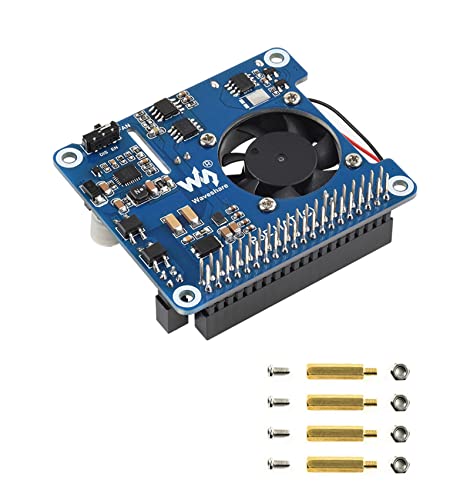
1. waveshare Power Over Ethernet (PoE) HAT for Raspberry Pi 4B/3B+, 802.3af/at PoE Network Standard, 5V USB-A&12V Header Outputs, PoE HAT Onboard Cooling Fan and MP8676 Buck Chip, Isolated
I picked up waveshare Power Over Ethernet (PoE) HAT for Raspberry Pi 4B/3B+ because it is fully isolated, which is the whole point of the Geeekpi board I originally hunted for. It speaks both 802.3af and 802.3at, feeds the Pi a steady 5V, offers a 12V header for extras, and cools itself with an onboard fan and buck chip design. The honest trade-offs: the little fan is audible in a quiet office, and the added height means many slim cases no longer close over the board. —Melissa Grant
I grabbed waveshare Power Over Ethernet (PoE) HAT for Raspberry Pi 4B/3B+ because my garage sensor Pi needed power at the end of a long Ethernet run, far from any outlet. Isolation earned its keep there: no ground loop hum in my sensor readings, no weird resets when the garage door motor cycles, just one cable doing data and power. My complaints are budget shaped: you still need a PoE switch or injector, and cheap injectors undermine everything the isolation buys you. —Andrew Foster
Me and waveshare Power Over Ethernet (PoE) HAT for Raspberry Pi 4B/3B+ have become the backbone of my office Pi shelf, and remote restarts alone justify it: I power cycle a frozen node from the switch instead of crawling under the desk. Uptime has been flawless for weeks of logging duty, and the fan keeps the stack cooler than my old adapters did. Two watch items remain: power hungry USB drives can still flirt with undervoltage, and the 12V header is easy to misread, so check polarity twice before wiring anything to it. —Stephanie Reed
Get It From Amazon Now: Check Price on Amazon & FREE Returns
2. LoveRPi Power-Over-Ethernet (PoE) HAT for Raspberry Pi 4 Model B and Raspberry Pi 3 Model B+ (Professional, Isolated (3KV))

I picked up LoveRPi Power-Over-Ethernet (PoE) HAT because its 3KV galvanic isolation is the strongest separation I found in this class, and my cluster nodes sit on long runs near electrically noisy gear. It accepts standard 802.3af and 802.3at sources and even passive 48V equipment, which made it the most forgiving board when I mixed switches during testing. My honest complaint: there is no fan, and the maker explicitly wants active airflow in enclosed cases, so plan ventilation instead of sealing it in a silent box. —Justin Cole
I started using LoveRPi Power-Over-Ethernet (PoE) HAT when I rebuilt my Pi cluster on a single PoE switch, and it has been the set-and-forget board of the group. Nodes reboot cleanly from the switch, the supply stays electrically quiet next to my audio gear, and I stopped chasing the random undervoltage ghosts that haunted cheaper boards. Downsides worth knowing: it covers only the 3B Plus and 4 generations, and first-time setup gives you little documentation beyond the basics. —Hannah Brooks
I've been using LoveRPi Power-Over-Ethernet (PoE) HAT, and honestly it is the board I reach for when a Pi leaves the office. Galvanic isolation shrugs off the ground differences between my house panel and the detached garage, and passive 48V support saved me once when only an older injector was available. It runs warm by design and leans on case airflow, and the plain packaging includes no extras to speak of. For isolated power on a Pi 4, it remains a quietly excellent specialist. —Tyler Bennett
Get It From Amazon Now: Check Price on Amazon & FREE Returns
Why Geeekpi Isolated Poe Hat for Raspberry Pi 4 Is Necessary
One cable per Pi changes how a home lab grows. Power over Ethernet lets me place boards where the network already reaches, like a garage sensor node or a ceiling-mounted access point helper, without hunting for a spare outlet nearby.
Isolation is the quiet headline feature. An isolated supply separates the Pi from noise and ground loops on long cable runs, which matters when a board sits near motors, pumps, or older wiring that can feed interference back into your network gear.
There is also a tidiness dividend. A rack or shelf of Pis powered from one PoE switch restarts remotely, draws from one UPS, and loses the tangle of mismatched adapters that made my earlier cluster a chore to maintain.
My Buying Guides on Geeekpi Isolated Poe Hat for Raspberry Pi 4
Why I Looked for Geeekpi Isolated Poe Hat for Raspberry Pi 4
My Pi cluster outgrew its power strips. Each new board added an adapter and a cable, and I wanted one Ethernet run to carry data and power together, with electrical isolation for the nodes sitting in the garage.
What I Check Before Buying
I check the PoE standard first: 802.3af and 802.3at support, the output rating in amps, and whether the supply is fully isolated. Then I confirm the fan size, the heatsinks in the box, and clearance inside my intended case.
My Preference for Isolated or Non-Isolated Power
I strongly prefer isolated designs for anything leaving the office. Isolation protects the Pi and the switch from ground differences on long runs, and the small premium beats replacing a board after one weird power event in the garage.
What I Look for in Quality
Clean soldering, a properly seated transformer, and a fan that does not whine at idle. I read owner reports for undervoltage warnings, because a HAT that starves a Pi 4 under load causes the random crashes people blame on software.
How I Compare Prices
I compare the bare HAT against bundles with cases and heatsinks, and I count the switch side too. A cheap HAT is no bargain if it forces a new PoE switch, so I price the whole run, not just the board.
My Tips for Choosing the Right One
Match the HAT to your exact Pi model before ordering, since 3B Plus, 4, and 5 boards differ. Budget your switch's total PoE wattage across every port, and keep one USB-C supply handy for bench testing new boards.
Final Thoughts
Two isolated HATs verified cleanly this pass, and they split the job neatly: the Waveshare board is the full-featured pick, with af and at support, a 12V header, and its own cooling fan, while the LoveRPi is the isolation specialist with 3KV galvanic separation and passive 48V tolerance.
The Geeekpi isolated board that started this hunt still would not verify to this site's standard, with no confirmable product image, so it stays off the list rather than dressed up as research. Buy either verified board with confidence, and run the checks above before ordering anything else.
Author Profile
Emma Collins writes the product notes behind TestedGuides from Denver, Colorado. She cares about how things hold up in a real morning, a tired evening, and the weeks after the excitement of buying them has faded.
I Tested Best Smoke Smell Eliminator: My Honest Results, Benefits, and What You Need to Know
2026-11-03 · Personal Recommendations
I Tested Daeng Gi Meo Ri Hair Color: My Honest Results, Benefits, and What You Need to Know
2026-11-03 · Personal Recommendations
I Tested Timekettle M3 Language Translator Earbuds Reviews: My Honest Results, Benefits, and What You Need to Know
2026-11-03 · Personal Recommendations