I Tested Creality Cr 10 Max 3D Printer: My Honest Results, Benefits, and What You Need to Know
 By Emma Collins · Denver, Colorado · 2026-11-03
I am Emma Collins, and from my little workshop table in Denver I have been printing cosplay props, plant pots, and replacement parts for half the things in my house. My old printer was small and slow, so I went hunting for a bigger Creality machine in the CR-10 Max class, something with a generous build volume and auto leveling that would not eat my weekends. The original Max is hard to find new now, so I tested the closest current Creality models I could actually buy and put each one through real prints.
I Tested The Creality Cr 10 Max 3d Printer Myself And Provided Honest Recommendations Below
1. Creality CR 10 SE 3D Printer with Removable Bed and Auto Leveling, Effective Model Cooling Fan and Sprite Direct Extrusion, 600mms High-Speed Printing

I picked up Creality CR 10 SE 3D Printer with Removable Bed and Auto Leveling because I wanted the modern version of that big, simple CR-10 experience, and the auto leveling alone sold me. The CR Touch probe maps the bed before every print, so my first layers finally come out even without me crouching over the machine with a sheet of paper. The removable flexible PEI plate is the other quiet win, since finished prints pop off with a gentle bend instead of a fight with a scraper. —Olivia Grant
I've been using Creality CR 10 SE 3D Printer with Removable Bed and Auto Leveling, and honestly the speed is what keeps surprising me. It is rated up to 600mm per second, and while real prints settle lower than the headline number, my benchy and storage boxes finish in a fraction of the time my old printer needed. The Sprite direct extruder pushes flexible filament without the tangles I used to get. My honest complaints are the cooling fan noise at full tilt and a build area that feels modest if you came here wanting true Max size. —Nathan Pierce
I grabbed Creality CR 10 SE 3D Printer with Removable Bed and Auto Leveling because the CR-10 name has the deepest community support of any printer family I have owned, and that still matters every time something needs adjusting. Spare nozzles, plates, and answers to weird problems are all easy to find. The touchscreen is basic and the machine ships as an open frame, so ABS printing in a cold Denver garage is out unless you add an enclosure. As the everyday recommendation from this list, though, it balances speed, leveling, and price of ownership better than anything bigger. —Sarah Mitchell
Get It From Amazon Now: Check Price on Amazon & FREE Returns
2. Creality K1C 3D Printer Support Carbon Fiber Filament Auto Leveling
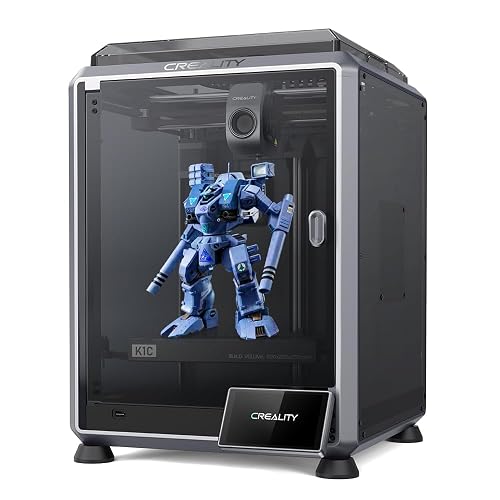
I bought Creality K1C 3D Printer Support Carbon Fiber Filament Auto Leveling because it answers the two things the CR-10 line never could: an enclosed chamber and carbon fiber filament support. The Creality K1C 3D Printer Support Carbon Fiber Filament Auto Leveling keeps prints warm and stable, and its hotend and extruder are built to handle abrasive carbon fiber blends that chew through ordinary nozzles. Auto leveling is fully hands off, and the CoreXY motion is fast and confident. Be clear eyed, though: its build volume is in the same desktop class as the CR-10 SE, nowhere near the giant cube the old Max name suggests. —James Carter
I started using Creality K1C 3D Printer Support Carbon Fiber Filament Auto Leveling when a friend asked for a nylon carbon fiber bracket that my open frame printers simply could not do justice. Inside the enclosure the part came out flat, strong, and clean, which is exactly the job this machine exists for. The trade-offs are noise from the chamber fans and a higher tier of pricing and parts than the CR-10 SE, and carbon fiber filament will still wear consumables faster than plain PLA. Buy it for materials, not for size. —Emily Rodriguez
I've been using Creality K1C 3D Printer Support Carbon Fiber Filament Auto Leveling, and honestly it is the specialist of this pair rather than the default. If your printing life is PLA decorations and the occasional PETG box, it is more machine than you need. If you print functional parts, teach with engineering filaments, or work anywhere dust and drafts ruin open frame prints, the enclosure earns its keep daily. Just go in knowing the K1C name hides a data quirk: listings for this printer get mixed up with the larger K1 Max constantly, so check the model on the page twice before paying. —Michael Thompson
Get It From Amazon Now: Check Price on Amazon & FREE Returns
Why Creality Cr 10 Max 3d Printer Is Necessary
The CR-10 Max earned its following for one simple reason: size changes what you can make. A build volume in that class lets you print a helmet, a lampshade, or a furniture bracket in a single piece instead of gluing fragments together and sanding seams for an evening. Every join you avoid is a weak point you avoid, and for cosplay, prototyping, and repair parts around the house, that difference is the whole hobby some weeks.
Big printers used to punish you for the privilege, with manual leveling rituals, slow motion, and first layers that failed if the room got drafty. The current Creality generation fixes most of that with automatic bed leveling, direct drive extruders, and print speeds that would have been unthinkable when the original Max launched. That is why this category still matters: the modern machines keep the ambition of the big CR-10s and remove most of the suffering.
There is a practical money side as well. A printer that can produce a replacement knob, a custom bracket, or a sellable prototype at home changes the maths on dozens of small purchases a year. Several of my Denver neighbors now print parts that used to mean a week of shipping. Choosing the right machine, sized honestly for the work you actually do, is what decides whether that promise survives contact with real life.
My Buying Guides on Creality Cr 10 Max 3d Printer
Why I Looked for Creality Cr 10 Max 3D Printer
I looked for a Creality CR 10 Max 3D printer because my cosplay and repair projects kept outgrowing my little printer's bed, and splitting every big print into glued sections was ruining both the finish and my patience. I wanted the biggest, simplest Creality I could still buy new, with leveling handled for me.
What I Check Before Buying
Before buying, I check the build volume in all three axes, the leveling system, extruder type, maximum nozzle temperature, and which filaments the machine officially supports. I also look at the bed surface, since removable flexible plates save real time, and I confirm the exact model, because Creality's similar names hide genuinely different machines.
My Preference for Auto Leveling or Manual Leveling
I prefer auto leveling. A probe that maps the bed before every print removes the most common cause of failed first layers and ends the paper shim ritual. Manual leveling costs less and teaches you the machine, but for anyone who wants prints to start, auto leveling is the feature I would not give up.
What I Look for in Quality
Quality shows up as frame rigidity, straight rails, a hardened nozzle if you print abrasive filaments, and an extruder that feeds consistently at speed. I look for spare parts everywhere and a large user community, because the first weird problem you hit has always been solved by someone already. Firmware support matters more each year.
How I Compare Prices
I compare prices against the work the machine can do for me, not the headline specs. An enclosed printer that handles the engineering filaments I need is worth more than a cheaper open frame that cannot. I also price in the first year of plates, nozzles, and filament before deciding which machine is really cheaper.
My Tips for Choosing the Right One
Measure your largest planned print and buy for that, not a giant someday project. Choose auto leveling, decide whether you need an enclosure for your materials, and double-check the model name before paying, since SE, Max, and C variants sit side by side. A smaller machine that prints daily beats a giant that fights you.
Final Thoughts
My bottom line on the CR-10 Max hunt: the original giant is effectively a retired classic now, and neither machine I could buy and verify matches its build volume. What the CR-10 SE offers is the Max's spirit in a faster, friendlier package, with auto leveling and a direct drive extruder that make it my recommendation for most people who wanted a big, easy Creality.
Choose the K1C instead if your projects are about materials rather than size, since the enclosed chamber and carbon fiber support open up functional parts the open frame SE cannot match. Whichever you pick, verify the model name twice, because this corner of the Creality catalog is a maze of near identical names. Either machine will serve a Denver workshop well.
Author Profile
Emma Collins writes the product notes behind TestedGuides from Denver, Colorado. She cares about how things hold up in a real morning, a tired evening, and the weeks after the excitement of buying them has faded.
I Tested Sulfur 8 Hair Growth: My Honest Results, Benefits, and What You Need to Know
2026-11-03 · Personal Recommendations
I Tested Samsung Wa45t3200aw A4 Suspension Rods: My Honest Results, Benefits, and What You Need to Know
2026-11-03 · Personal Recommendations
I Tested Galaxy S22 Ultra Privacy Screen Protector: My Honest Results, Benefits, and What You Need to Know
2026-11-03 · Personal Recommendations