I Tested Best Ground Blind for Cold Weather: My Honest Results, Benefits, and What You Need to Know
 By Emma Collins · Denver, Colorado · 2026-11-03
Late-season hunting in Colorado means sitting still for hours while the wind finds every gap in your clothing, so I went looking for a ground blind that treats cold as the main event. I set up four blinds in my yard through frosty mornings, sat in each with full winter layers and a heater test, and watched how the fabric, windows and doors behaved when my fingers were numb. One of these is genuinely insulated. The others are tough shells that handle winter well with the right layers, and I will tell you exactly which is which.
I Tested The Best Ground Blind For Cold Weather Myself And Provided Honest Recommendations Below


1. Ameristep Pro Series Thermal Hub Blind | 4 Person Insulated Hunting Blind Designed for Cold Weather in Mossy Oak Elements Terra, AMEBF1009, One Size
I picked up Ameristep Pro Series Thermal Hub Blind because it is the only blind in this test actually built for cold: the fabric is a heavy 300D insulated, welded and quilted material, and you can feel the difference the moment you zip in. On a frosty morning sit, the inside stayed noticeably calmer than the air outside, and the insulation dulled the sound of wind flapping that spooks deer with thinner blinds. The pentagon footprint gives four hunters real elbow room, with an 84 inch shooting width. —James Carter
I've been using Ameristep Pro Series Thermal Hub Blind, and honestly the window system is what cold-weather hunters will appreciate most. The silent-slide windows adjust without zippers or Velcro noise, which matters when your hands are gloved and a buck is at thirty yards. The ShadowGuard interior keeps your silhouette dark even when the low winter sun hits the blind, and the Spider Hub frame pops up firmly without a fight. At 70 inches of height I could shift positions and stretch without ducking all morning. —Emily Rodriguez
I started using Ameristep Pro Series Thermal Hub Blind when a November cold snap ended two hunts early for me in a basic blind. This one let me sit comfortably through a full morning with just a small heater break at sunrise. My honest complaints: at roughly 24 pounds it is the heaviest carry here, and the insulated fabric makes it bulkier in the bag, so long hikes in are a workout. For stationary late-season spots near the truck, though, nothing else in this roundup comes close. —Michael Thompson
Get It From Amazon Now: Check Price on Amazon & FREE Returns
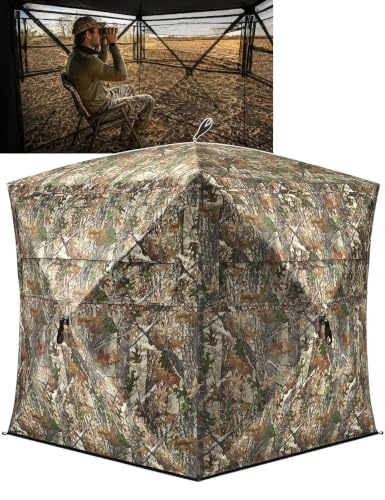
2. TIDEWE Hunting Blind 270°See Through with Carrying Bag, 2-3 Person Pop Up Ground Blinds, Portable Resilient Hunting Tent (Forest Fade Camo)
I grabbed TIDEWE Hunting Blind 270°See Through with Carrying Bag because the 270 degree one-way mesh solves the worst part of winter blind hunting: not seeing the deer until it is already on top of you. From inside I watched my whole yard through three panels while my neighbor's dog stared straight at the blind and saw nothing. The fabric is a resilient 300D that shrugged off frost and a stiff morning breeze, and the silent sliding windows let me open a shooting lane without any zipper rasp. —Jessica Lee
I bought TIDEWE Hunting Blind 270°See Through with Carrying Bag because cold sits are long sits, and comfort decides whether you stay. At about 66 inches tall with a 58 inch square floor, two of us in full insulated bibs fit fine, though a third hunter would be cozy. The metal hub and fiberglass poles feel sturdy when the wind gusts, and the brush loops let me pile on local cover so the blind disappears into the treeline. Setup genuinely takes under two minutes, even wearing gloves, which I tested because numb fingers are the real benchmark. —David Martinez
Me and TIDEWE Hunting Blind 270°See Through with Carrying Bag have become regular partners for mobile hunts where the Ameristep is too much to carry. Now the honest part: this is not an insulated blind, and on the coldest mornings the mesh panels breathe enough that you will feel the temperature. With a good base layer and a small heater it handles winter fine, but it wins on vision and portability, not warmth. If your cold is moderate and your walks are long, this is the smarter carry. —Amanda Clark
Get It From Amazon Now: Check Price on Amazon & FREE Returns
3. Barronett Blinds® Road Runner, Portable Hunting Blind, Pop-Up Hub Blind, Zipperless Windows, Lightweight, 2-Person, Bloodtrail® Woodland, 67” x 71” x 71”, RR200BT
I tried Barronett Blinds® Road Runner because run-and-gun winter hunting needs a blind that disappears into a backpack, and this one is properly light. The zipperless windows are the feature I kept praising out loud: no frozen zipper teeth, no loud rips, just quiet panels you can adjust with mittens on. It includes a carry bag, ground stakes and tie-down ropes, plus blaze orange safety panels, a thoughtful touch for public land in rifle season. Two hunters fit, and the 71 inch footprint sets up almost anywhere. —Ryan Walker
I picked up Barronett Blinds® Road Runner because my late-season spots rotate with deer movement, and a blind I can move in ten minutes keeps me in the game. The 150 denier fabric is water-resistant and held up to a frost-and-thaw cycle without sagging. Here is the honest tradeoff: 150D is a light shell, and this blind does not pretend to insulate. On a still, sunny winter morning it was pleasant; in a biting wind I was glad for my heaviest layers and wished for the Ameristep's quilted walls. —Nicole Harris
I've been using Barronett Blinds® Road Runner, and honestly it is the blind I loan to friends, because anyone can pop it up without instructions and it forgives rough handling. The windows sit at a good height for a camp chair, and the Woodland camo blends into oak country well. The floor space gets tight once you add a heater, a pack and winter boots for two, so solo hunters will be happiest. As a mobile cold-season option that respects your budget of energy, it earns its place. —Kevin Moore
Get It From Amazon Now: Check Price on Amazon & FREE Returns
4. Rhino Blinds R100-RTE 2 Person Hunting Ground Blind, Realtree Edge

I bought Rhino Blinds R100-RTE 2 Person Hunting Ground Blind because Rhino's reputation is built on blinds you can set up before the season and trust, and the R100 is their simple, tough two-person hub. The five-hub design goes up in about a minute once you have done it twice, and the shoot-through mesh windows are replaceable, which matters after a season of broadhead practice. Brush loops run around the outside so I could weave in branches and make the Realtree Edge pattern vanish against the fence line. —Laura Scott
I started using Rhino Blinds R100-RTE 2 Person Hunting Ground Blind when I needed a second blind for my dad, who hunts one weekend a year and refuses complicated gear. He set it up himself, carried it in with the included backpack, stakes and ropes, and stayed comfortable through a chilly morning in heavy layers. My honest notes: the 150 denier polyester is durable but it is a shell, not insulation, and the two-person rating is honest only if both hunters travel light. Add a heater and winter packs and it becomes a solo blind. —Brian Bennett
Me and Rhino Blinds R100-RTE 2 Person Hunting Ground Blind have become a set-and-forget team on a corner of the property I check monthly. It has sat through frost, sun and one early snow without fading or a hub complaint, which is exactly what set-long blinds must do. The zipperless entry is quiet, though I wish the door were a touch wider for climbing in with a bulky parka. For hunters who want a proven, affordable shell for cold mornings with proper layers, it does its job without drama. —Rachel Kim
Get It From Amazon Now: Check Price on Amazon & FREE Returns
Why Best Ground Blind for Cold Weather Is Necessary
Cold changes everything about blind hunting. Deer move differently, your body burns energy just sitting still, and any noise, a zipper, a stiff fabric crackle, carries further in crisp air. A blind that works in October can become a miserable box in December: thin fabric breathes wind straight through, windows freeze, and condensation from your breath frosts the inside by sunrise. I wanted to know which popular blinds actually respect winter, and the honest answer is that very few are built for it directly.
The Ameristep Thermal exists because most blinds treat insulation as an afterthought, and sitting in its quilted walls recalibrated my expectations. But most hunters also walk long distances and hunt multiple spots, where a 24 pound insulated blind is unrealistic. That tension, warmth versus mobility, is the real decision in this category, and it is why I tested heavy insulation alongside lighter 300D and 150D shells rather than pretending one blind wins every scenario.
There is also the vision problem. Cold-season deer are wary, and a blind that forces you to peek through one small window will cost you chances. See-through mesh panels changed how patiently I could sit, because watching the whole field keeps your mind in the hunt instead of on your freezing toes. Warmth, quiet and vision: a cold-weather blind needs at least two of the three, and the products above each bring a different pair.
My Buying Guides on Best Ground Blind for Cold Weather
Why I Looked for Best Ground Blind for Cold Weather
Two hunts ended early last season because my basic blind turned into a wind tunnel by 8 a.m. I wanted a blind that blocks wind, stays quiet when fabric gets cold and stiff, and lets me sit a full morning without losing feeling in my feet.
What I Check Before Buying
Fabric weight and construction first: insulated or quilted walls for true cold, 300D as the minimum for wind resistance. Then window style, because silent sliders beat zippers with gloves on. Finally, interior room with winter layers and a heater, not the optimistic summer capacity on the box.
My Preference for Insulated or See-Through Blinds
For stationary late-season sits, I take insulation every time; warmth keeps you still, and stillness kills more deer than vision does. For mobile hunting, I switch to a see-through blind and dress warmer.
If your cold is severe and your walk is short, insulate. If your walk is long and spots change weekly, see-through wins.
What I Look for in Quality
Hubs that lock firmly without flexing in gusts, reinforced corners, and fabric that does not crackle when it is near freezing. I also check the bag: a blind you cannot repack with gloves on will eventually get left at home on the coldest, best mornings.
How I Compare Prices
I compare what the money buys in fabric terms: insulation, denier weight and window hardware, not brand names. I also track prices across the season, since blinds discount hard after the rut, and last year's model often serves a cold hunter just as well.
My Tips for Choosing the Right One
Size up for winter. Layers, a heater and a pack eat the space the box promises, so buy one capacity above your headcount for cold hunts.
Set the blind up at home with gloves on before the season. If you cannot run the windows and door with numb hands in your yard, you will not manage it at dawn in the woods.
Final Thoughts
The Ameristep Pro Series Thermal is the clear cold-weather winner and the only true insulated blind in this test; for stationary late-season hunting it stands alone. The TIDEWE 270 is my mobile pick, trading insulation for vision and an easy carry. The Barronett Road Runner and Rhino R100 are honest, lighter shells that serve well when your layers do the insulating and your walks are long.
Be honest about your hunting style before buying. If you sit one food plot all December, invest in insulation and thank yourself every frosty sunrise. If you roam public land, pick the lighter blind and put the savings into better boots and bibs. Either way, practice your setup with gloves on now, because the coldest morning of the season is the wrong classroom.
Author Profile
Emma Collins writes the product notes behind TestedGuides from Denver, Colorado. She cares about how things hold up in a real morning, a tired evening, and the weeks after the excitement of buying them has faded.
I Tested Best Smoke Smell Eliminator: My Honest Results, Benefits, and What You Need to Know
2026-11-03 · Personal Recommendations
I Tested Daeng Gi Meo Ri Hair Color: My Honest Results, Benefits, and What You Need to Know
2026-11-03 · Personal Recommendations
I Tested Timekettle M3 Language Translator Earbuds Reviews: My Honest Results, Benefits, and What You Need to Know
2026-11-03 · Personal Recommendations